

Automatic Immunity
Doctor, did you say there is no Off Switch?


“The body is often likened to a machine, but it is so much more than that. It works 24 hours a day for decades without (for the most part) needing regular servicing or the installation of spare parts... It is a miracle that we exist at all.”
— Bill Bryson, The Body: A Guide for Occupants (via Penguin Random House) [1]
I am leaving my Grim Reaper alone for a spell for a 1,900 word ramble. This piece introduces a sub-series within Two Years a Vampire called Hidden Register. I will let the reason for this navigational heading spin out in what is ahead here and in future writing.
Let us lighten the tone, air out that serious voice as if shaking dusty linen. I am choosing another light topic: autoimmunity? Let me filter the prose like a polarizing filter over a lens focused on blue sky. A critique of my academic writing and early prose attempts was that my thoughts, at least as they poured out in text, were glib. Was it a complement and a critique?
There is a term called immune hyper-reactivity, and over the years, I have learned that my body expresses it well and insistently presents this condition to the medical community: “Thank you for referring this very interesting patient to me.” A doctor in 1982 wrote that sentence. He wrote about my body. Recently a physician assistant at Holden Cancer Clinic, University of Iowa, spoke of my body’s knack for fending off the nasty microbes that afflict us all. I rarely get sick, but when my body succumbs, well . . . “Boy Howdy!”
My body wants to win one for the Gipper. My immune system goes all in, bars no holds, places the 3 a.m. all-in bet. Heads straight down that rabbit hole. Gives the 110 percent and aims to please so completely that its occupant can only grip the rollercoaster bars.
“Put me in coach!” says my body’s macrophages, as I lay stiff on the couch. My killer T-cells are killer, man. But my body no butts. If you must know, my butt became a royal pain at times—on account of this hyper-responsive immune system—the butt’s proximity to the tail bone. “Ya goin’ ovahboahd!”
Hard experience taught me that the side effects of a roguish, Machiavellian immune system are painful and persistent. Later knowledge suggests that the better analogy might be to imagine a nineteenth-century drunken sailor wandering into a house looking for, shall we picture together, a newly minted friend. This friend already has a friend. who is also present in said house. A bit of a stretch, yes.
One stalls. Allow me to venture further forward.
Note: based on his later research, the interesting patient finds that there is no causation or genetic correlation between cutaneous T-cell lymphoma diagnosed in 2019 and the tenuous Reiter’s syndrome diagnosis of 1982. He asserts his trust in his general practice physician, Dr. Olson, the consulting physician. But verify.
Patient expressly claims that he uses “Machiavellian” in a metaphorical sense.
Here is the letter explaining what ails me in the summer of 1982. I can say that the situation puts a sizeable wrench in my summer plans. The fun continues into late fall, a first semester as a junior transfer student. More on that as we proceed.
My mother saved this letter and additional reading matter pertaining to the bout with my over-eager immunity. I am grateful that she did.
+++
August 24, 1982
Stewart Olson, M.D.
2255 73rd Street
Des Moines, Iowa 50322
RE: Price Flanagan
Dear Stewart:
I saw your patient, Price Flanagan, on August 23, 1982. Thank you for referring this very interesting patient to me. As you know, this is a 20 year old single white male who was in good health until the middle of July 1982 when he developed inflammation in his right ankle which spread to his left ankle, left knee, right wrist, and several finger joints.
+++
[Patient states that he rode his bicycle from his home in rural southeast Polk County to his grandparents’ house in Nevada. Patient explains that his grandparents were hosting the 4th of July, and that “Grandma makes really good homemade ice cream.” He wore flipflops on the bike ride and the top of his feet and ankles were severely sunburned during his three-hour ride. He claims that he will “never do that again!”]
+++
The doctor continues: He was hospitalized here at the beginning of August and was found to have a sed rate of 38, negative rheumatoid factor, negative ANA. Joint aspiration of the left knee revealed a white count of 5,800 with 42% neutrophils and no growth. He was treated with Indocin, 50 mg. with each meal, and he started to improve. Currently he is having several hours of morning stiffness, mainly in his ankles. He can do his routine activities, but his ankle pain still limits him from doing more.
+++
[Patient politely and with a mild curiosity looks on as the rheumatologist inserts large needle into his left knee to suck out fluid that showed signs of inflammation but no infection. Patient looks at rheumatologist for any signs of glee as the well- trained doctor performs the procedure. “This is as hard on me as it is for you, buddy.” Doctor does not say that.]
Pathology of the amber-colored knee joint fluid says he does not have rheumatoid arthritis or Lupus. Patient blithely recalls to anyone who will listen to him how he was admitted to the hospital on crutches and that he could not support his well-built 185-pound body in the prime of its youth under his own strength.]
+++
Furthermore writes the rheumatologist: Review of systems shows that a week or two before he developed his arthritis he did have an illness characterized by fever, chills, and diarrhea which lasted for about 4-5 days and then cleared up. He did have some frequency of urination during his hospitalization but he denies any dysuria or urethral discharge. Review of systems is negative for conjunctivitis, nail or skin changes, mouth sores, pleurisy, and GI problems. Family history is negative.
[Interpretation: the rheumatologist notes a gastro-intestinal illness preceding the arthritic event. Patient denies painful peeing and does not have inflammation in the eye. Doctor notes the asymmetric nature of the arthritis, although he does not include it in the letter. That is tell-tale.
Price’s oxytocin level is high. Oxytocin is the “love chemical,” and more accurately it’s a chemical a glad secretes when the human is stressed. A stressed person seeks community, their peeps. Ha, but might there be a flirtation between patient and the pretty housekeeper each morning?]
Physical Exam: Blood pressure 138/90. The general exam was unremarkable. There were no mucocutaneous abnormalities. Examination of the bones, joints, and muscles revealed there was trace to 1+ inflammation of the right wrist, trace in the PIP of the left long finger, 1-2+ inflammation of the ankles, and 1+ inflammation of the MTP joints. He had no sausage toes and no inflammation of the Achilles tendon at this time.
The “Smoking Gun”: Additional lab work done at the last hospitalization revealed HLA B27 was positive. X-rays taken at that time revealed normal ankles and feet, and one SI joint seen on x-ray was within normal limits.
Impression: Inflammatory arthritis predominately involving the lower extremities. It is possible that since the patient is HLA B27 positive that he may have Reiter’s syndrome, however, the thread of evidence for this is a bit tenuous since he denies any urethritis. He did have a diarrheal illness before his arthritis and this may have been the initiating trigger. Other diagnoses such as seronegative rheumatoid arthritis do not seem quite as likely at this time and his clinical course has not been consistent with rheumatic fever.
Page 2
Re: Price Flanagan
August 24, 1982
Prognosis: He is showing gradual improvement and I would recommend that he continue his Indocin, 50 mg. four times a day if tolerated. I told the patient that if he is having significant problems after about another month he may wish to consult a rheumatologist in Springfield, Missouri, where he is going to school.
+++
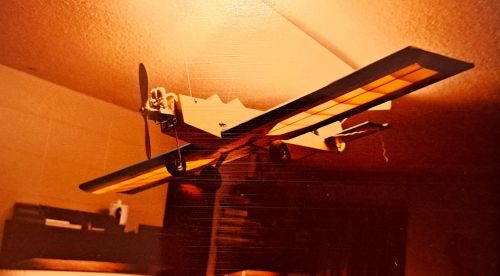
[The summer past slowly. I rested at home in my room, comfortable, but Reiter’s Syndrome hampered my mobility. I built a radio-controlled model airplane. Dad built a tilted bench in the workshop so that I could more easily reach the working model, which model airplane hobbyists call Das Ugly Stick. Model builders like to adorn their instance of the Ugly Stick with a WWI German Airforce insignia. I covered mine with yellow-dyed silkspan that I sealed with the standard airplane fabric “dope.”
I missed my job at a local moving and storage agent. I loved the arduous work, the sweating and getting in shape after a year of academics. Eight hours or more of walk-running between the moving van and a house: sometimes 14,000 pounds of a family’s home goods and furnishings. Took a drop-frame trailer for that.
I remember the very last move that I worked on before becoming ill. The warehouse manager and I drove the single-axle and short trailer to somewhere in either Madison or Warren County. It was a nice summer day, not too hot. A woman, in her sixties was moving. I do not recall where or why—to live near one of her children? She lived in this cool A-frame house with a spiral staircase.
The woman, with graying dark hair, had the typically graveled voice from smoking. All morning, as we loaded her belongings, she sipped coffee. In her coffee she laced a thimble of Wild Turkey from a “handle.”
One of my younger cousins brought me lunch. I typically preferred lying on the floor, reading a book. I cannot recall which ones. My youngest paternal cousin was such a sweet girl. She later died by cancer, in her thirties. My Dad’s brother lived next door; they both had built houses in the country during the tail end of the great rural-urban shift. My parents are both reluctant suburbanites. The moved from a suburb named Urbandale to three acres of land with a steep Burr-oak filled hill, a creek, and a remnant of an old pasture.]
+++
The consulting letter closes:
Thank you for your referral.
Sincerely,
Nathan Josephson, M.D.
Internal Medicine (Rheumatology)
NJ/bam
+++
By late fall 1982, the need for crouches faded. I attended a Christian College in Springfield, Missouri. During biology class that fall, a young lady cried profusely as the poor instructor tried to explain how evolution works and asserted that the earth, truly, was not less than 10,000 years old. I knew I had made a mistake but made the best of it.
A young man, a preacher’s kid with frizzy hair, asked/demanded that he lay his sweaty hands on my ailing left knee. We were in my third-floor dorm room (I had refused the resident-head’s offer to switch to the first floor and there was no elevator. I felt as if I had returned to the Middle Ages, and the doktor was laying hands on my ailment, and incanting. That is what doctors did then.
I learned how to write good sentences and essays at that college. I met so many good people and nurture a connection with them to this day. Town boomers called Springfield, Missouri, and the Queen City of the Ozarks on billboards and brochures. Free of the arthritis, I rode my bicycle in the company of friends on the Ozarks highways and byways in the Ozarks. I met my wife there. Cannot complain.
Two years after Rebecca became my wife, we moved to near the eastern edge of the Ozarks, Carbondale, Illinois. She went to grad school to study literature, a specialty in Anglo-Irish lit, and I managed a motel.
The motel I worked at had brand that relied on a man’s homespun voice saying, “We’ll leave the lights on for ya.” Need I spell it out: yet another on/off switch is implied?
The diagnosis became not tenuous two years later: Reiter’s syndrome, now called reactive arthritis. Patient denies any ability to foresee the future and does not know that this episode is just the warm up for things to come.