

Kinetic Joy Part I
Endurance: The Stage Is Set

Greatness Thrust Upon Me: The Seussian Loop
I am thinking now of the character Malvolio in Shakespeare’s play Twelfth Night.
Malvolio says, “Some are born great, some achieve greatness, and some have greatness thrust upon ‘em.” In the action, he is reading a letter addressed to him, a letter designed to expose his pomposity.
Cutaneous T-Cell Lymphoma thrust a vampire life upon me, but the kinetic greatness of youthful aerobic success was born of my own lungs and legs.
In my essay What Brought Me Here: A Visit from My Grim Reaper, I write, “The dream contained a motive power of its own, and I am dream-speaking of the grim reaper — my demise.”
I have not demised.
But I speak of death. I am not dead; dead I am not. I do not like death. I am dying. Dying I am. Am I dying? Yes, I am dying.
I seek a slow dying; I am dying, dying a death not born of this cancer, a death emptied of what caused the hyper-visual dream of my grim reaper.
I train on a tautology, one with a stance that is steely cold in its back-pedaling spin of life-not-death—a patterned, stubborn rumination like the Seussian loops of Green Eggs and Ham—a toddler’s logic.
But now, I am focusing on life—of motive power and kinetic joy!
The Motive Power of Youth
The Tour de France (TDF) stage race captivates high-output cycling enthusiasts for most of July, and Stage 15 ran on July 20, 2026, the day I started writing this essay.
While others all but pine for the coming of the World Cup Football season, I have reconvened my fascination with the Tour de France. I did so after many years ignoring it due to a performance enhancing drug (PED) era defined by one man: the fascinatingly flawed alpha pedalist Lance Armstrong.
Motive Power: the door of memory now opens to youthful kinetic energy of another type.
My mind sees another species of power where the circular motion of bicycle pedals translates to linear velocity, and where the draconian non-linearity of wind resistance calls for epic power.
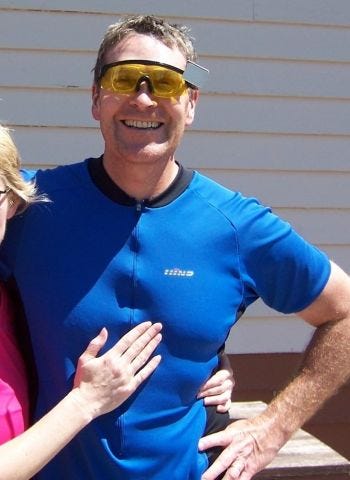
The graphic novel panel thus opens with a character named Thunder Thighs. He is not a new creature. Thunder Thighs was born in the fast-paced, headlong era of my late twenties.
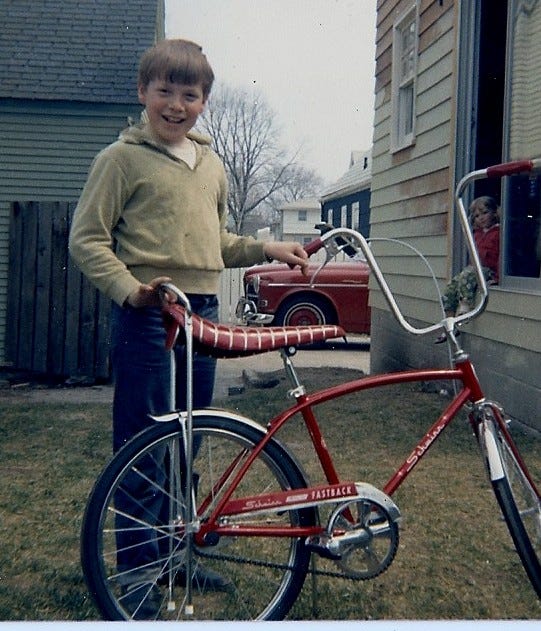
I rode my bicycle over the arcing roads near Springfield, Missouri, in the late 1980s and early 1990s. My bicycle was my steely friend, although in reality it was aluminum, and Thunder Thighs became my avatar.
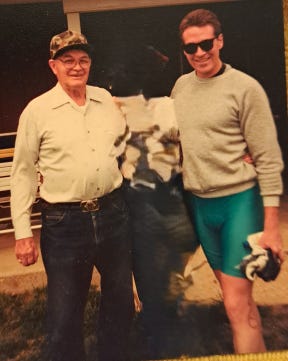
As the editor of The Tube, the monthly newsletter of Springbike Bicycle Club, for the 1989–1990 season, I exercised a degree of editorial privilege to start a monthly column called The Spare Tube. There, Thunder Thighs made his debut.
I lack a copy of that essay, but have one of the May 1989 edition:
I turned 27 this month. Really it was no big deal. I spent a large chunk of my birthday weekend shouting anathemas at a head wind while perched on a two-wheeled contraption that most sane people decommission when they get their first car.
The Doctor and The Poet
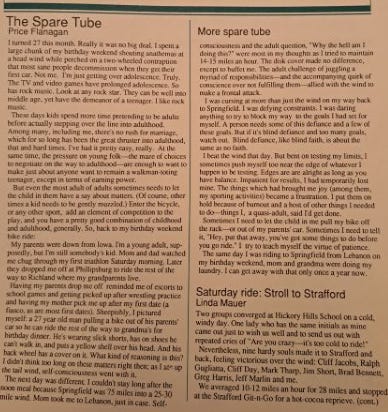
Allow me to introduce another character: a physician who joined the ranks of cyclists in 1987 seeking personal bests in a time trial.
Let’s meet him this way: I was looking for another bicycle, one more bump-forgiving in its frame geometry.
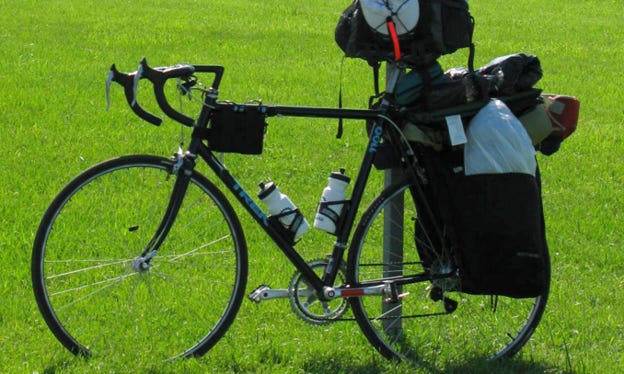
The Doc—which is one way he shall be called—had such a bike. He had decided to upgrade to a lighter carbon fiber ride. His almost new Trek 1100 fit the need for a comfortable and durable road bike suited for Thunder Thighs’ newest bicycling adventures.
Soon he would engage in a little-known genre of bicycling called randonneuring, a type of mostly self-supported endurance bicycling. The French cycling community founded this two-wheeled hobby in the early 20th century, and it caught on in the U.S. during the late 1980s.
During the sale, which was brokered by a loquacious bicycling buddy, the Doc began talking about my literary predilections. He had learned, for example, that I was attending graduate school to study literature and practice creative writing—and to have plenty of time to ride a bicycle.
The Doc, seemingly out of the blue, began calling me a poet, Le poète, to use the French.
“What interest does a poet have in time trialing and long-distance bicycling?”
Well, now, I felt, shall we say, mildly amused. I gave Le Doc a decent shit-eating grin. Whatever I said to him is lost to the ages.
But The Doc seemed to be throwing down a gauntlet. Would I pick up the symbolic bicycling glove?
Was The Doc coming for me—not me, but my time trial average speed of 25.3 mph? My personal best for the 9.8-mile time trial held at Wilson’s Creek National Battlefield Park was 23:15, reached in 1990.
The full reckoning and a complete settling of the score occurred the next summer. For now, we can simply say, “Let the games begin, Doc.”
Not The Dark Science of the Pro Peloton
But first, a question arose in the 1989 time trial season at our local bicycle club.
The friend who had arranged my purchase of the Trek 1100 mentioned to me that he wondered about the Doc’s vast, and fast, improvement.
Were Performance Enhancing Drugs (PEDs) involved? A physician would certainly have access to them. The middle-aged physician was looking fit and thin as he proudly stood by his bike.
By the way, Le Doc appeared so very colorful in his tight fitting cycling kit. He looked almost like a primping mallard drake when he lined up to try for a new personal best.
For several years, Springbike Bicycle Club volunteers organized the time trial, which was staged every other Thursday evening after the park closed to visitors. I am not sure these volunteers were ever thanked to the level that they deserved.
The course went clockwise around the 4.9-mile park loop. It presented me, a 190-pounder at the time—a Clydesdale in the runner community—a challenge with its stairstep hills at the 3-mile point in the loop.
I had to use every portion of my ample power to reach 30-plus miles an hour on the flat section and apply massive acceleration on the down hills if I were to move closer to the twenty-three minute mark.
Thunder Thighs could produce epic bursts of power, an estimated 550 watts on the 1.3 mile straight rolling along at 32 to 33 miles an hour. Stand in a 30-mile an hour gust for a sense of the resistent force of air at those speeds.
My performance plan was not all that regimented; it involved copious sessions of loop-like fartlek-style training—brisk tempo riding, followed by intense blasts at near muscle-burning redline.
“Last to the convenience store buys the Gatorade, Yoo-hoos, and Snickers bars!” (Yoo-hoo, pronounced something like “you who” was at the time my cycling buddy’s favorite choclolote-flavored beverage.)
I was unseriously serious about my fitness regime and, for that matter, my life’s plan. So, it doesn’t require any great degree of ratiocination to conclude that I loved the word fartlek.
To a degree, my lifestyle regime in the early 1990s resembled that of the renowned, yet flawed and EPO-juicing, PED-fueled German cyclist Jan Ullrich, more than that of the famously blood-dope enhanced, machine-like, Lance Armstrong. Ullrich was known for his off-season partying and clubbing.
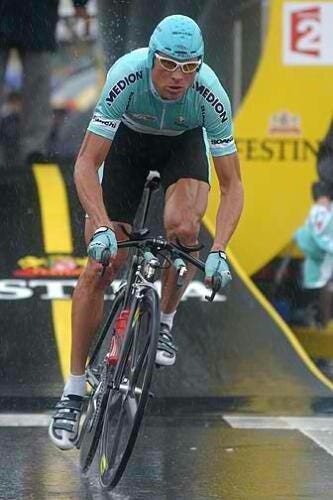
However, in contrast to the Lance Armstrong and Jan Ullrich era of the pro peloton, no Erythropoietin (EPO) and absolutely no blood transfusions were ever in my ambit. Thunder Thighs would not stand for it even if he had access or chose to gain it.
I loathed that EPO and PEDs had become the norm in pro cycling and later on commonplace in amateur cycling races in the United States and Europe.
Today, very fit weekend warriors-turned-dopers are quietly getting disqualified and banned by anti-doping officials, especially in Europe. Sometimes, they flee the scene of a race if word gets out that a doping-control has been set up at the finish line.
These well-trained amateur cyclists source their meds anywhere and anyway they can—from gyms, black markets, and complicit and non-complicit physicians. High Street ambition has led to a cult of back-alley cheating.
Turning Blood to Molasses
At one point, Thunder Thighs cried foul. He was aghast to learn that in the early days of EPO doping in the pro peloton in the 1990s, several European racing cyclists died in the night while sleeping.
Their blood, thickened by the heme production stimulated by EPO, had thickened to the viscosity of molasses; they died of stroke, and they were fit to the gills and too young—in their 20s and 30s.
Team coaches, the directeurs sportifs, had team caretakers, called soigneurs wake their charges in the dark hours of early mornings. Perhaps like young vampires, these young men were told to move around so that their thick blood would not pool and congeal.
Synthetic EPO, of course, has a valid use: it is prescribed to people with chronic kidney disease. Kidneys produce EPO, and with the disease so goes the natural production of it.
A Sense of Pedal Power
People who ride a bike for pleasure and relaxing exercise might not have a clear sense of the raw power required to reach a 30-mile per hour pace for any amount of time.
A racing cyclist’s power output is measured in watts.
One might think of a light bulb when the word wattage comes to mind. Or there is a rush to get ready for work, and hair styling dryer is set to high, 1,500 watts. Ever get a strand of hair caught in the heating element? That smell comes from electricity current commonly expressed as watts.
But watts are difficult to picture. In an attempt to impart a sense of the effort involved to ride a bike fast, I will switch to calories burned.
Have you ever consulted one of those charts that lists an activity and the number of calories burned in some length of time?
The Joy of the Redline
I remember that wondrous blast through the air—thirty-two miles an hour at aerobic redline during a 9.8-mile time trial. Let us dissect the effort involved.
For a mile and change, I power over the flat section of the 4.9-mile loop; my legs ache, my lungs gasp, as I struggle to mount yet one more effort to achieve and hold over 30 miles an hour.
The wind resistance makes it feel as if my bicycle is moving upriver against a powerful current.
I can still picture the moment: there it is, the number 32 pegged on my cyclometer, as the full force of a wind gust pushes against my face and body.
Groans and grunts escape me as I try—well-trained amateur that I am—to keep that 32 showing on my bike computer. All I had to do was keep it pegged for 1.3 miles, the length of the flat section that follows the valley of Wilson’s Creek.
I allowed myself to ease up slightly after rounding a sweeping corner. A set of short, steep, hills was coming up.
Thunder Thighs’ pedaling stays fluid, deceptive to the casual eye, but his inner effort is anything but elegant.
Riding at redline—physically unpleasat in the moment—piqued the senses of agency and of mastery. I will include a playlist I made for this time trial, a cassete tape, in The Vampire’s Glossary (coming soon).
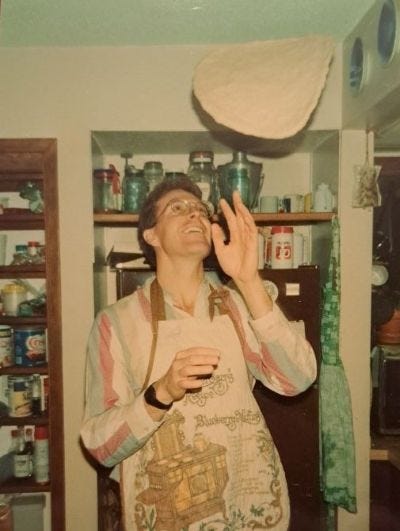
An aside: during high school, I worked at a local pizza joint. Eventually, I learned to make my own hand-tossed pizza. Beer and pizza became a favorite reward after hard efforts on the bike.
Now, a degree of rationality becomes a companion to my epically fluid, Thunder Thighs-focused joyous thinking.
I have made a chart that represents the level of energy expenditure during my Thunder Thighs era of bicycling. I list calories expended in the first column with the thought that it more clearly evokes a sense of the level of human effort required to keep a bike rolling for any period of time at 32 miles an hour.
Calorie Focused Performance Table
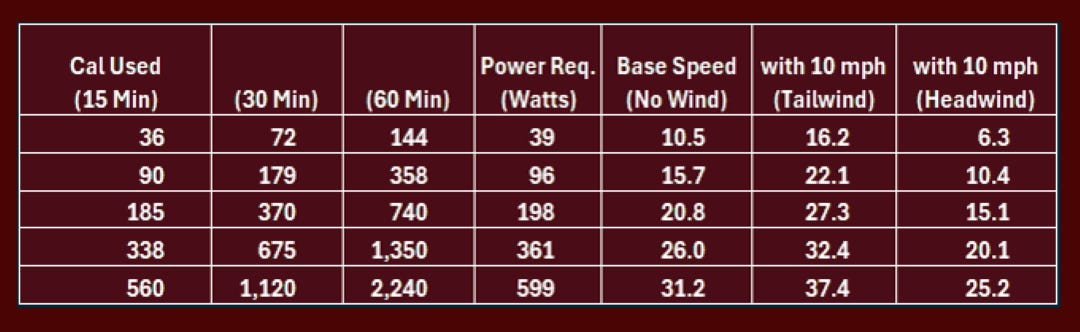
The peak output of a 560 calorie burn in fifteen minutes results in an estimated power setting of a constant 599 watts.
When my avatar achieved his goal speed for two minutes and thirty seconds, he was burning burning close to 37.3 calories every minute! For that brief period, which seemed much, much longer, he produced a near pro-level 6.4 watts/kilogram of body mass.
Notice that in contrast to the 31.2 mile per hour row in the chart, the line showing calories burned when riding at ten miles an hour are magnitudes less: 36 calories in fifteen minutes requiring 39 watts of power.
Even a ten-mile per hour breeze has a big impact on pace. This explains the presence of the tailwind and headwind columns.
Even though Thunder Thighs was not a pro cyclist, his reaching pro-level power for a brief, wonderfully fluid, all energy-vectored-to-the-pedals thrusts of intent motion, brought him deep kinetic joy.
I tend to think that my experience of the bicycle, my efforts on it, helped me to engage a spirit of resiliency when faced with cancer all those years later. Durable fitness also gave my avatar Thunder Thighs the ability to take it to The Doc.
Part II: Stay tuned for the thrilling Adventure of Thunder Thighs and his victory over Le Doc in a bicycle race.
I also explore in some detail the invalidating behavior of blood-sucking professional bicyclists, drawing a parallel to my own valid vampiric habitudes that cancer thrust on me and the endurance it required.