

Wayne Holmes: Straddling the Fence
By Price Flanagan


Professor Wayne Holmes navigated the worlds of his rural Ozark heritage and higher education. He was a Drury College English teacher who balked at any suggestion to sanitize his identity or conform to orthodox academic expectations. He died in 2014. I wrote this profile in 1989 or 1990. The author revised the article to reflect years of experience and changing times.
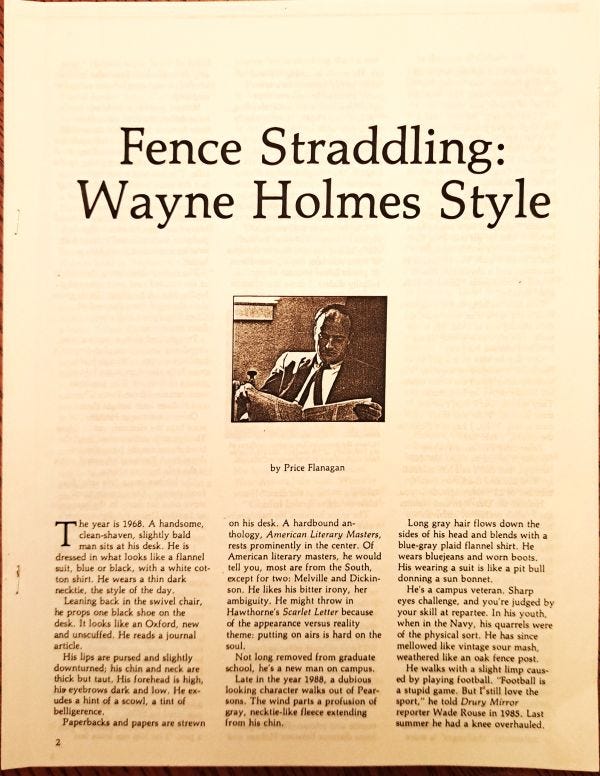
The year is 1968. A handsome, clean-shaven, slightly bald man sits at his desk. He is dressed in a dark suit, a white cotton shirt, and a thin cravat. Leaning back in the swivel chair, Holmes props a black shoe on his desk. What story is he reading? His lips are pursed. His chin and neck are thick and taut. His high forehead sits below a balding head. Is that a scowl on his face, or is he posing for the camera with a serious academic expression?
Paperback books and paper clutter his desk. A hardbound anthology, American Literary Masters, rests prominently in the center of the desk; he must be teaching a survey class this semester. Most of the American literary masters, he would argue, are from the South except for two: Melville and Dickinson. He is drawn by Melville s bitter irony and Dickinson s ambiguity. He might include Hawthorne s The Scarlet Letter, asserting that appearances are deceiving. Not long removed from graduate school, Wayne Holmes is a new man on campus.
Late in the year 1988, a dubious-looking character walks out of Pearsons Hall. The wind parts a profusion of gray, necktie-like fleece extending from his chin. Long gray hair flows down the sides of his head and blends with a blue-gray plaid flannel shirt. He wears blue jeans and worn-out boots. For him, wearing a suit is like a pit bull donning a sun bonnet.
He is a campus veteran by now. His sharp eyes challenge, and he appreciates skill at repartee.
When he was in the Navy, his quarrels were sometimes physical. He has since mellowed, perhaps like a barrel forgotten sour-mash whiskey. (Over lunch one day at a place called Ebbets Field—yes, in Springfield, Missouri—told me that he had stopped drinking. Meanwhile, I took my fill.)
Holmes has weathered like an oak fence post. He walks with a slight limp caused by playing football. “Football is a stupid game. But I still love the sport,” he told Drury Mirror reporter Wade Rouse in 1985. Last summer he had a knee replaced. Ahab, Melville s heroically crazed whaling captain, had his peg leg made of whalebone; this man has a knee held together by plastic and steel.
I like salvage, he once told a few impromptu guests at his home. I’m salvage myself. He built much of the homestead from salvaged material. The house sits at the bottom of an Ozark hillside on which he raises about as many Angora goats as he has acres.
Wayne Holmes tells stories about farting horses and stubby, 120-pound snakes. People on both coasts have honored him for his mile-long fibs. He measures his words carefully, like a learned man, but he speaks in an accent and a rhythm as contoured as the southwest Missouri s hills and hollers that he loves.
This man walking out of Pearsons Hall is the same man who wore the dark flannel suit in 1968. He is the same man who, as a young dandy, briefly disowned his kin. One day he was with a girl he particularly wanted to impress: “We were walking down the street when my family drove by in a truck. They waved, but I didn’t return their gesture. “Who was that? my date asked. “Why, I haven t a clue in the world,” I told her.
Years later, Professor Wayne Holmes is proud to claim his hill heritage, but do not call him a hillbilly. If you do, the Drury faculty member of twenty-two years might raise a mocking fist as if to deck you.
The Wayne Holmes of the Ozark region and the Wayne Holmes the professor of English literature: ambivalence has shadowed him for a long time. Wayne Holmes has tracked uncertainty. His is not a life of crisp lines and clean-knotted neckties. He has an apt image for ambivalence: straddling the fence between two tenuous ways of life. The fence he straddles is strung with barbed wire.
Straddling that gnarly fence is not a comfortable position. That was his sentiment when he spoke at a 1988 dinner held for retiring Drury faculty, among them another native of the Ozarks and former athletic director Bill Harding.
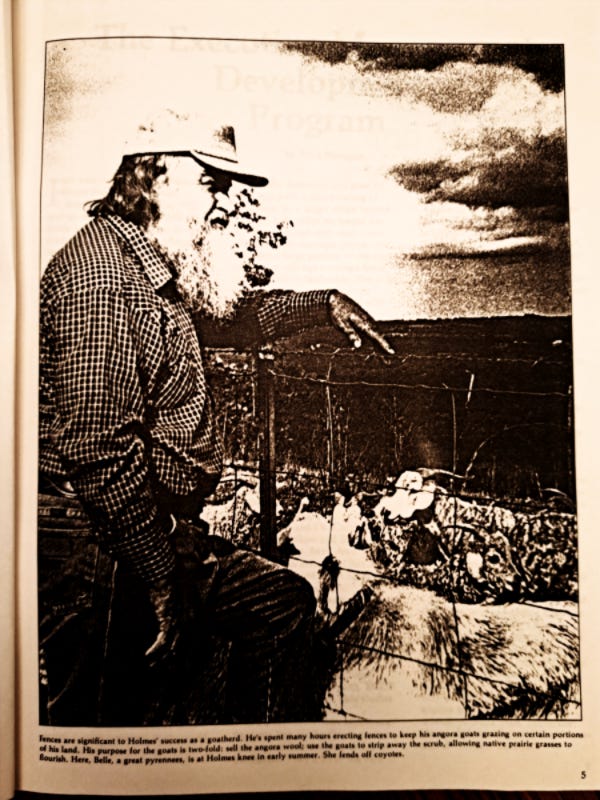
While leaning on a fence on his ranch, Holmes makes no apologies for his not so erstwhile ways to people in the academy. He feels as if he might have to defend his bookish profession to his Ozark friends and neighbors. No wonder he revels in ambiguity and irony, and he seeks to raze stereotypes to erect understanding in its place.
A few years ago, Holmes had a row with an Eastern gentleman scholar. How Holmes put it. The man advised Holmes to take a crash course in Standard American English, the strait-laced voice of television news casters, in even the Mid-Atlantic and New England dialects. Holmes had been sharing his maverick theory on Shakespeare’s Othello at a New England literary meeting.
“Oh, he meant well enough, but what he was really telling me was that in the eyes of those scholars, my IQ was about forty points lower because of my hillbilly dialect.” Holmes says he came close to taking a swing at the man. The space between his hands narrows to the thickness of a plank. His brows plow a deep furrow; his face reddens. The Ahab in Holmes is stirring. Notice a tendency to overstate?
“Now that I think about it,” an associate observes, “I see why he likes Moby-Dick. Wayne Holmes is a bit like Captain Ahab.
The pigskin, “that stupid sport,” was once a pressure relief regime for Holmes. Age came and time wore on. The need for pressure relief valve was obviated. Enter the farm as a source of respite and release. The hills put some distance between Holmes and any stray academicians who mistake his dialect and rough-hewn ways for an intelligence downgrade.
Holmes and his wife, Mary Lou, have driven the fifty miles from their farm to Springfield since 1980. Mary Lou teaches math at Springfield Public Schools. They lived in Springfield before returning to the land they love best. The last stretch of road to the farm is a dirt path littered with gravel the size of boulders.
The house reflects shrewd, make-do Ozark qualities. He and Mary Lou took a hodgepodge of found materials and enlarged an existing sandstone shack into a home. The rafters shouldering the weight of the vaulted roof once spanned a Joplin, Missouri, train depot. Dark green slate scrapped from the roof of Clara Thompson Hall covers both the floor and the roof.
Two stained-glass windows, one round and one rectangular, impart a meditative aura to the home though Holmes pays little attention to traditional holiness. He purchased them later, after they were salvaged from Stone Chapel at Drury College. Other windows at the homestead once kept the elements out of Clara Thompson practice rooms. The wooden front doors are the retired storm doors from Pearsons Hall. A wood stove is the sole heating source.
The kitchen has a pie safe they use for dry goods storage. The cast-iron cookstove once sat dusty in the basement of another Drury faculty member’s house. The Holmeses eat on a gray marble table that served once to make fudge.
Like his house, Wayne’s dogs and the way he speaks of them reveal his Show-Me temperament—unaffected, stoic, and proud. Willy, a Komondor with fur as thick as unshorn wool, prefers that his master not pet him. “We call him the troll.” During the day, the Willy the dog wanders by the bridge on the lane. At night, Willy patrols alongside Belle a Great Pyrenees, Shasta another Komondor, and Ranger, Belle’s pup by Willy.
Daniel, a wire-haired heeler, stays in a pen. I let him run loose last year until he killed one of my best billy goats, Holmes notes. That goat was the only one to fight back when Daniel herded them. (A billy is a goat that has its procreative functions intact.)
Save for the ticks, the summer heat, and a bothersome neighbor, his homestead is a calming realm. But Ozarks life has a harsh aspect that Holmes and his dogs all mirror. “Do not coddle either people or animals” could easily be a rule to live by here. Forebears eked out their livings, and many of their progeny struggle as well. When Holmes was a boy, his family lived in Needmore, Oklahoma. He says it is aptly named.
The land and the culture sometimes constrain, especially for one who enjoys reading as much as hunting. Soggy weather is a good time to go squirrel hunting. His brothers shamed him because he sometimes chose to stay inside and read—and books were scarce.
“I still have trouble sitting down and reading if I know there are chores I could be doing.” Wayne Holmes the professor of literature. He is at a place where books are much preferred over hunting rifles.
His neighbors and townsfolk might look askant at Holmes the professor. Has the putative gibberish of academia sullied him? “Even though I don t have a doctorate, they’ll call me Dr. Holmes. They are joking, but there is ambivalence in their voices. I enjoy the respect they are giving me.”
He says his love of language began with storytelling and progressed naturally to literature.
During his time in the Navy from 1950 to 1954, Holmes swapped stories with other seamen to pass the time. Initially, Holmes says he was taciturn about his Ozarks tales. But he soon learned that his stories were as good as or better than any others. Rouse calls Holmes s stories more shocking than a wet light socket.
Holmes applies this voltage in his classroom. “I think shock is a valid device.” He uses it to prod values reflection. He wants students to look at loosely held ideas from more than one viewpoint. “I lose a few.”
He claims that he knows which students can manage the additional current. One student says that our professor s pedagogical style could flabbergast students. But this senior communication student was not so dumbstruck as to become speechless: “He’s a good teacher. He makes you think. “
One year, a pre-med major from the Ozarks did not appreciate the Holmesian method. The student later asked me for a medical school recommendation. Of course, I wrote one.” A senior English and French student claims having almost a minor in Wayne Holmes.
He encourages students from the region to let go of provincialism. Holmes seeks to instill pride through growing up in Ozarks. He remembers one student’s equivocations: The student said southwest of Springfield was home. In some give and take, Wayne Holmes learned that the student’s hometown was Hurley. He wanted the student to own their heritage.
By this point in his career, Holmes holds up human dignity as firm as a weathered post oak tree. His durable spirit inspires his students without irritating them.
If Holmes believes he is right, not much can sway him. He firmly maintains his interpretation of Othello, which he conceived while a graduate student at the University of Missouri-Columbia (M.A. 1964).
Peers in the academic community think his theory is absurd. Holmes remains steadfast and has a stock rebuttal: “I frankly can take any class, undergraduate and graduate, and in an hour convince them that they’ve been led down the primrose path.” Holmes put this stake in the ground in a 1985 Springfield Leader and Press story.
In the case of Othello, the primrose path is the notion that Desdemona is one of literature’s most pristine women. On the contrary, Holmes contends: she is more sensuous than virtuous. He argued his case in the first issue (1978) of The Upstart Crow, a Shakespeare Journal published by Drury College and the University of Tennessee at Martin. His detractors could well find upstart crows an apt phrase for Holmes and his take on Othello.
Holmes notes that an Ozarks courting tradition of paddling (petting) a woman’s hand influenced his conclusion. Cold, clammy hands are a bad sign, he warns. In one scene, Iago, the villain, says to Othello, “Didst thou not see her paddle with the palm of her hand?
Holmes thinks Desdemona s hands are far from clammy, and that she shared affections with Cassio well beyond friendship long before she married Othello. To Holmes, “Shakespeare includes many other clues that we ought to pay attention to. They lead to mixed feelings toward this apparently, but not truly, pure woman.”
His Southwest Missouri roots provide him with a unique lens through which to interpret literature. It is based on ambivalence and ambiguity. The tension he has felt while straddling the fence enables him to spot the fences other people straddle. “We all live in two worlds.”
The author remembers Holmes saying that people exact a cost if we straddle a psychological fence for too long, or too deceptively: I was struck many years ago by Hawthorne s message in The Scarlet Letter, he told the Mirror, Drury’s student newspaper. “I see no need to dress or act differently at Drury than if you were to come and see me at my home in Barry County. This is who I am.“
If people disagree, Holmes s riposte remains similar to the ending of his paper on Othello: “Through a close study of the lines and passages in the most authoritative edition of a play, is it possible to approach the truth (the author s original meaning? I think it is. If not, then I propose a new error.”